Compiled by J. Brenz Kriewaldt
My Father Emil Theodor Brenz Kriewaldt was born on the 9th March 1903 at Lobethal South Australia. He was the youngest son of Rev. Emil Paul Gerhard Kriewaldt and Emma Bertha Kriewaldt nee Eberlein.
After completing his primary education at the Lutheran schools at Lobethal and Tarrington he enrolled at Concordia College, Adelaide in 1916 for his secondary education. However this was only to be for a very short time as on the 25rd. of May his beloved Father died of tetanus at Tarrington, Vic. at the age of 46.
Later on this year Grandma and her four boys, Fred aged 20, William 17, Martin I5, Emil 13 and adopted son Eddie left for the United States.
The family settled in Grandma’s home town of Shawano, Wisconsin where they stayed for about 18 months. While at Shawano, Emil studied at Concordia College in Milwaukee.
In June 1918 the family resettled in Requa, Northern California , which is about 330 miles North of San Francisco. Grandma writing to the Shawano Journal on June 13, 1918 states that Fred and Willie are working at a cheese factory in Requa, Martin is working on a dairy farm, Emil is doing odd jobs around the town, and my adopted child Eddie is outdoors all day long having the time of his life. She also states that in the fall Martin goes to the University of Berkeley and Emil to Concordia College Oakland. Emil proved to be an exceptional student as his report card of the second semester 1918-1919 shows that his lowest marks were 95% for English and his highest being 100% for Latin. ln his last year at Oakland he competed in a poetry competition which involved 9 other colleges. Emil won 1st prize for “Good Friday”, 4th prize for “Sonnett” and 6th prize for “A dream of home”.
After graduating at Oakland he enrolled at his Father’s alma mater in 1922: Lutheran Seminary, St. Louis Missouri. As a student he became involved in a historic event, namely the first broadcast of the Missouri radio station K.F.U.O. from the old Seminary building in South St. Louis. After the first broadcast had been made, and the announcer and technicians had left around meal time, Student Kriewaidt was left to man the station and attend to any inquiries “on air”.
Emil attended the Seminary from September 1922 until his graduation on June 10th. 1925.
During his time at College and Seminary he had to live very frugally because his widowed Mother did not have the means to fully support him financially. Consequently he took many Jobs during vacations such as farm work in Nebraska, grape picking in California, school teaching in Wisconsin 1924, working on the railroad; in a fish cannery and a shoe store.
He returned to Australia after graduation and received a call to serve the Karoonda parish of the Lutheran church which is in the Mallee of South Australia. Life there must have been pretty rough, first of all being single, secondly not owning a motor vehicle and thirdly not having a church building to worship in. Services were held in Hoff’s homestead until members increased forcing the services to be held outside the home under a large tree. During his 5 years at Karoonda a church was finally built even though times were very hard due to the depression, poor harvests and grain prices.
In 1930 Emil received and accepted a call to serve the Brinkworth, Blyth and Canowie Belt Parish. He was to remain there for the next 36 years.
On May 24th, 1933 he married Rubina Wegener from Palmer, South Australia. From this union three sons were born: Brenz, Neville and Peter. Neville and Peter subsequently followed our Father and Grandfathers footsteps and also became pastors in the Lutheran Church,
At Brinkworth he played golf on Saturday afternoons for a short time until the elders suggested to him that it would be more profitable for him to be home in his study preparing his sermons for Sunday. This was rather ironical as within another generation members were absent from church due to bowling and other sporting commitments.
For many years he belonged to a rifle club using a regulation Lee Enfield .303 rifle. He was quite a good shot and won a number of trophies for his prowess.
During his years at Brinkworth he established another congregation at Clare and also at Yacka. He was very interested in the youth of the church and was for many years editor of the youth magazine, The Luther League Monitor. He was also very much involved with the Churches work with Aboriginals being a board member and later chairman of Aboriginal Missions.
This involved a great deal of extra work such as travelling to meetings in Adelaide with Government officials a round trip of over 200 miles and many trips on unsealed roads to the mission stations of Koonibba and Yalata on the far west coast of South Australia which meant a round trip of 1000 miles, quite often in his 2 cylinder 2 stroke, D.K.W. car.
During the war he tried to enlist in the Air Force at the same time as his Brother Martin, out was turned down because of his eye sight. Also during the war he joined a home defence force called the Volunteer Defence Force and participated in marching with wooden guns and throwing stones as make believe hand grenades.
He was very proud of his country of birth and even wrote to the Army Invention Directorate during the war with suggestions for a “Sticky bomb” and a use for Nitrogenous rock as a substitute for super phosphate which was in short supply.
Emil was also very community minded. He served for many years on the school committee, a director of a local community store, purchased and operated a school bus and served on various other committees.
His pastoral duties were many and varied, usually preaching 3 times a Sunday (with congregations 80 miles apart) attending 3 or 4 Ladies Guilds and Youth meetings 3 month and weekly confirmation lessons at most congregations, religious instruction lessons at schools, hospital visiting in the parish as well as Adelaide and attending the many congregational and parish meetings etc.
In fact, my two Brothers and myself saw very little of our Father except on Sundays when of course we were expected to attend all 3 services.
In 1971 there were a number of so called “peace marches” protesting about Australia’s involvement in the Vietnam War. My Father deplored all wars but he considered that once our servicemen were committed we should support them particularly when the protest marchers carried “Viet Cong” flags and shouted obscenities to anyone who disagreed with their philosophies.
He wrote a number of letters to the Adelaide papers stating his views and soon other letters followed from other writers both for and against the marches. Even though he received many personal letters supporting his views and stand, never the less I think he was considered by many to be a rebel. Our Father was also opposed to the timing of the amalgamation of the two Lutheran Synods. He believed that too many compromises were made in order to achieve a premature union.
In fact in those days a common phrase was “We agree to disagree”.
His stand on this issue made him somewhat of an outcast with some other pastors and church leaders, but I think he can be applauded for acting according to the dictates of his conscience.
He also took a keen interest in politics and received regular copies of proceedings of State and Federal parliaments over many years and wrote numerous letters to politicians either to praise or criticize them or their policies.
He attempted to retire in 1966 from Brinkworth but was persuaded to serve the Hillcrest congregation in Adelaide on a part time basis of 4 days per week at an annual stipend of $1680-. However he soon found out that he was working nearly 7 days a week, but of course only being paid for 4. During this time he was also appointed prison chaplain and regularly visited and conducted services at the Adelaide and Yatala men’s prisons and also the women’s rehabilitation centre.
ln 1972 he suffered a heart attack at the age of 69 which slowed him down somewhat. On the 7th September, 1975 he was privileged to celebrate the 50th anniversary of his ordination at the Dernancourt church (formerly Hillcrest.)
On the morning of Aug. 3rd. 1977 as he was about to leave home to give a talk on his prison chaplaincy at a Lutheran Women’s zone conference he suffered a massive heart attack and left this vale of tears to be with his Saviour whom he had faithfully served for 52 years and to rejoin his Father Mother and Brothers whom he dearly loved.
In summing up I would say we were indeed privileged to have such a loving, kind, tolerant, humble Father, Grandfather and Husband.
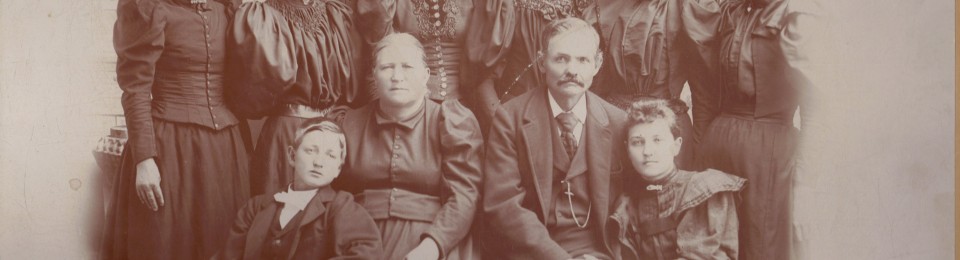
 Eberlein genealogy and photographs