
Posted by Kristen James Eberlein | Filed under Ephemera
05 Friday Oct 2012
Posted by Kristen James Eberlein | Filed under Ephemera
05 Friday Oct 2012
Posted in Newspapers
From DOUGLAS LOCKWOOD
DARWIN, June 12.
Mr. Justice Kriewaldt held a unique appointment in Australian law.
He was constantly called upon to impose penalties on aborigines who not only did not understand the white law but had a separate code of their own.
A Supreme Court Judge in any of the six States presides at perhaps 12 murder trials in his lifetime.
Martin Chemnitz Kriewaldt sat on 35 murder trials in his first seven years year and about 40 altogether.
A majority of those were tribal murders committed on native settlements and missions.
The evidence regularly showed that the black man in the dock had killed a tribesman on orders for his elders. Refusal to do so would have meant his own death at the hands of efficient tribal executioners.
In these circumstances Mr. Martin Kriewaldt was called upon more often than others to temper justice with mercy and always to draw upon his own knowledge of native customs.
Clemency
I never knew him not to be generous when generosity was desirable and the law made it possible.
Albert Namatjira served three months instead of six months’ gaol on a liquor offence because “the big feller judge” as he was known to the natives showed him clemency.
Frequently he allowed his deep understanding of human nature to influence his pronouncements from the bench.
In Alice Springs a month ago he directed that plaintiff and defendant in a civil action should go out in the sun and talk it over. They did.
He had what is perhaps the biggest circuit of any Supreme Court Judge of Australia — the 523,000 square miles of the NT, plus Cocos and Christman Islands in the Indian Ocean.
But I saw him in some odd corners of the outback, including a blistering week at Anthony Lagoon station on Barkly Tableland.
The temperature on the police station veranda where he heard a cattle duffing case was around 110 each day. The judge nevertheless appeared in his red fur-fringed robes on all occasions.
Dignity
Even in that remote wilderness he was determined to uphold the dignity of the court.
I remember a dramatic occasion when an accused man was found to have a .38 revolver in his pocket during the entire time the Judge heard his case.
Someone had forgotten to search him.
Mr. Martin Kriewaldt always helped junior members of the profession but was impatient of poorly prepared briefs. [Editor’s note: The clipping ends here; residue of tape suggests that there was another piece affixed.]
Source: Unidentified clipping, in the Frederic C. Eberlein genealogical files
05 Friday Oct 2012
Posted in Obituaries
The judge of the Northern Territory Supreme Court, Mr. Justice Kriewaldt, died in the Repatriation General Hospital, Springbank, on Saturday night. He was 59.
Mr. Justice Kriewaldt, who was appointed to the Territory position in 1952, was admitted to the hospital on May 30.
Mr. Justice Kriewaldt is survived by his wife and five children, three from his first marriage and two from his second.
They are Robert, of Adelaide; Michael, of Cobar (NSW); Martin and Helen, of Darwin, and Mrs. J. Greenslade, of Maitland.
The funeral will be held tomorrow after a service in the Lutheran Chhurch, Flinders street, beginning at 3:30 p.m.
Source: Unidentified newspaper clipping, Frederic C. Eberlein genealogical files
05 Friday Oct 2012
Posted in Wedding portraits
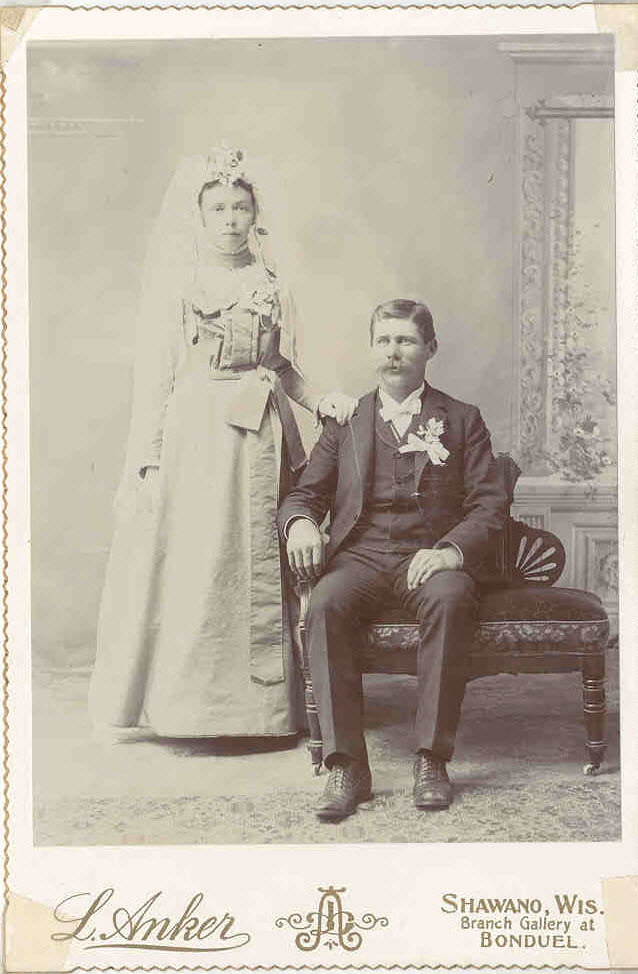
Wedding portrait, John Valentine Eberlein and Martha Florentine Köppen, 1891. Taken at L. Anker Studio, Shawano, Wisconsin.
05 Friday Oct 2012
Posted in Newspapers
… Mr. and Mrs. M. G. Eberlein and two children went to Green Bay Friday in their new auto. They went there to meet their two oldest children, Robert and Marjory who had been at New Hostein for a week, visiting relatives.
Source: Shawano County Journal, Tuesday, 7 August 1917
05 Friday Oct 2012
Posted in Gravestones

Gravestone for Robert William Eberlein, 1908-1918. Woodlawn Cemetery, Shawano, Wisconsin. Photograph taken by Kristen James Eberlein, November 2007.
05 Friday Oct 2012
Posted in Newspapers
DISEASE HELD IN CHECK IN CITY AND ONLY ONE CASE HAS BEEN SERIOUS
IMPROVING AT ALL THE CAMPS
Green Bay Reports That The Climax Has Passed There — Outlook Is Now Good
The Spanish Influenza epidemic is abating. In the city there are many cases but few of them are at all serious. Robert Eberlein, son of Mr. and Mrs. M. G. Eberlein is the one in Shawano who has been very seriously sick with the disease, and even yet is not out of danger, although this afternoon he is improving [1]. Green Bay and Shawano were the hardest hit, and the report from Green Bay last night says that the epidemic is held in check there. Clintonville has had no cases, and practically none in London, Appleton, or Oconto. In the East around Boston where the epidemic started, the condition is very much improved, and the reports this morning from Camp Grant and Great Lakes say that conditions are getting better there.
The measures taken by the city authorities to check the spread of the influenza here have been to close the schools, churches, places of amusement, public and private gatherings as far as possible. Ice cream can not be eaten in community dishes but must be taken home. No crowds are allowed to loiter in places of business. Today’s report shows a great improvement everywhere, and it is hoped that in our next issue we can report the danger practically passed.
Source: Shawano County Journal, Thursday, 10 October 1918
05 Friday Oct 2012
Posted in Gravestones
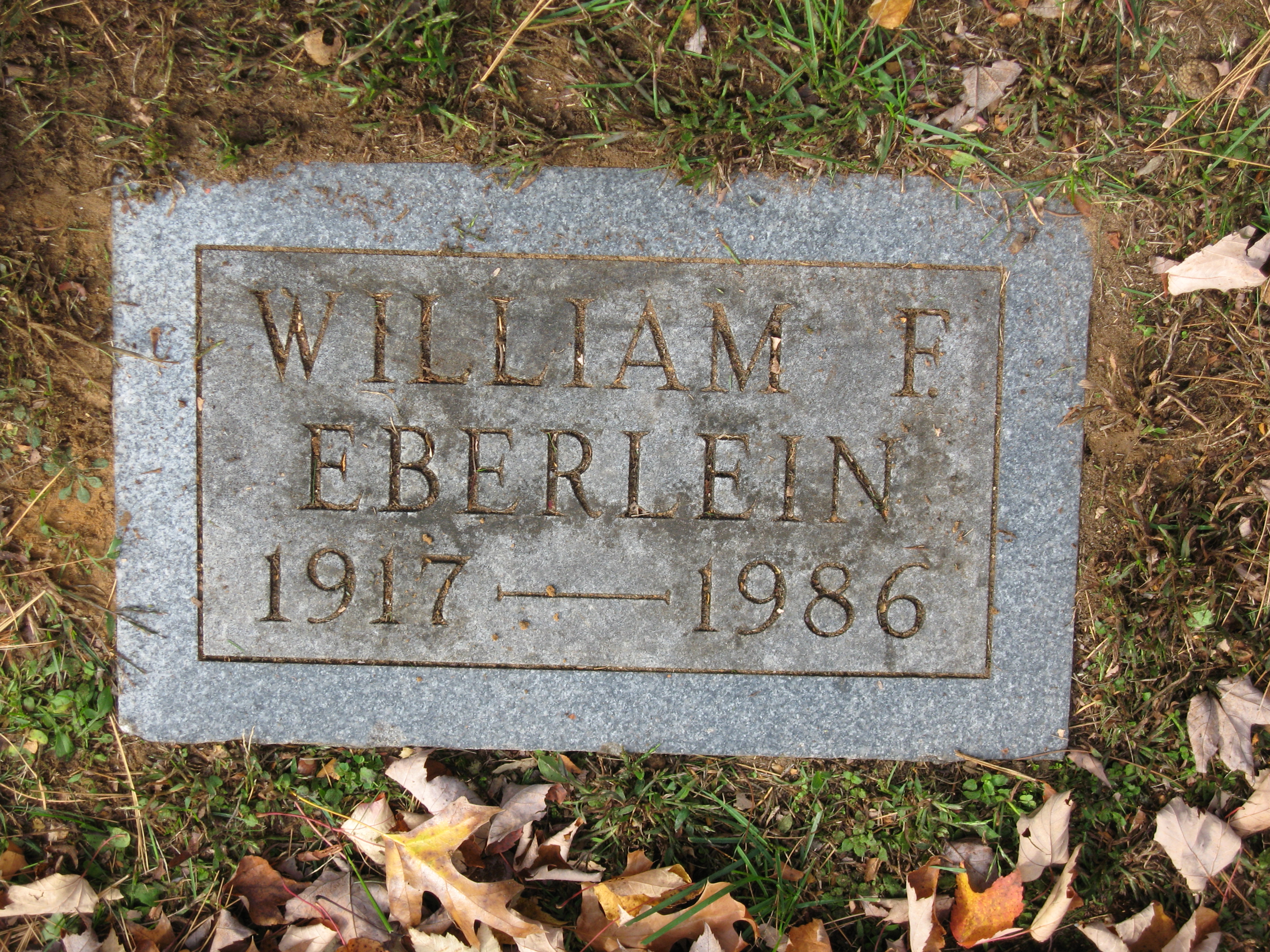
Gravestone for William Frederick Eberlein, 1917-1986. Woodlawn Cemetery, Shawano, Wisconsin. Photograph taken by Kristen James Eberlein, November 2007.
05 Friday Oct 2012
Posted in Newspapers
CLINTONVILLE — To an Australian who is in his graduate year at St..Louis Seminary, St. Louis, Mo. the celebration of Christmas here is much like it is in his home of Adelaide, Australia, except for the weather.
Peter Kriewaldt, who-intends to become a minister, is spending the holidays with a distant relative, Charles Mack, 80 Rohrer St.
The 24-year-old Australian’s grandfather, Emil Kriewaldt, was born in Pella (Shawano County) so he is visiting distant cousins while here for the holidays.
Kriewaldt observed that while Christmas is observed in his native land much like it is here, the weather is much different. He said it is now summer in
Australia, and when groups go out caroling, they are in shirtsleeves.
Church Service
The emphasis is very much on church services in Australia,during this season, he remarked. Kriewaldt was scheduled to speak at the 6 and 8:30 p.m. Christmas Eve services at St.Martin Lutheran Church.
Peter’s godfather, Rev. Emil Kriewaldt became a missionaryto Australia following his graduation from St. Louis Serminary. He died in 1917, and his widow and four sons came back to Shawano until about 1925 when they all returned to Australia. Peter’s father, Emil Jr., completed his education while in the United States and also became a minister, and is now in Adelaide, Australia.
Peter had gone through college and had spent two years in the seminary in Australia, when he interrupted his studies and went to Europe to study in
Germany for a semester;
Came in 1963.
He came to St. Louis in September 1963, and after one school year there, vicared for one year in a Chicago suburb. He is now in his last quarter at the seminary and will graduate at the end of February, 1966. He will return to Australia in March to take up a parish there.
Peter said he wanted to have the benefit of the seminary in St. Louis where there was a wider variety of classes than in Australia. Also, he said it was a
little bit of “wanderlust” that made him want to travel to Europe and then here.
Peter, the youngest in a family of three boys, said there are more luxuries and conveniences her[e] than in Australia. He said Australia is something like
the United States was about 20 years ago, but quickly added, “I don’t think it will be a sacrifice to return home.”
Source: The Post-Crescent, Friday, 24 December 1965: section B, page 1.
05 Friday Oct 2012

Posted by Kristen James Eberlein | Filed under Vital records
 Eberlein genealogy and photographs