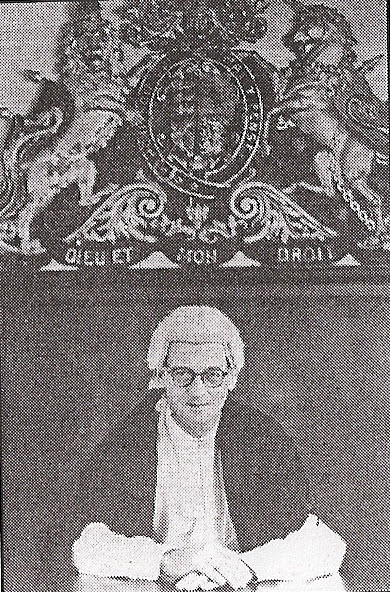
• About
  • Index of locations
  • Index of people
  • Navigation tips

Eberlein genealogy and photographs

Eberlein genealogy and photographs

Category Archives: Newspapers

Elmer Cronce dies while being transported to Federal court on moonshine charges

28 Sunday Oct 2012

Posted by Kristen James Eberlein in Newspapers

≈ Leave a comment

Tags

Prohibition, Richard A ("Elmer") Cronce (1863-1928)

Der in Shawano County überall bekannte Elmer Cronce erlitt am Mittwoch Morgen der vorigen Woche, als er von einem Prohibitionsbeamten wegen Verletzung des Volsteadgesetzes nach Milwaukee transportiert wurde, um sich vor dem Bundesrichter verantworten, auf dem Wege dorthin eine Schlaganfall. Dem er erlag. Er stand unter der Anklage “Moonshine” in Besitz gehabt zu haben, und da er die Bürgschaft von $1000 nicht zu stellen vermochte, wollte man ihn nach Milwaukee ins Gefängnis nehmen bis sein Behör an die Reihe kam. Cronce war für viele jahre Besitzer des Resorts an dem Clover Leaf Lakes und ein Charakter mit einen nicht guten Rekord. Er erreichte ein Alter von 62 Jahren.

Source: Volksbote-Wochenblatt, 19 April 1928.


English translation:

Elmer Cronce, well known in Shawano County, suffered a stroke Wednesday morning last week, as he was being transported by Prohibition officials to Milwaukee, where he was to appear in federal court under charges of violating the Volstead Act. He succumbed to the stroke. He was charged with possession of “Moonshine,” and since he was unable to post the $1000 guarantee, the Prohibition officals wanted to have him ready to remand to prison authorities, if necessary. Cronce was for many years the owner of the resorts on the Clover Leaf Lakes and a character with a dubious record. He reached the age of 62.

Translation by Kristen James Eberlein, 28 October 2012

F. Eberlein, Superintendent of Streets

25 Thursday Oct 2012

Posted by Kristen James Eberlein in Newspapers

≈ Leave a comment

Tags

Frederick J Eberlein (1834-1896)

— All parties who have paid their poll tax, are hereby notified to report to F. Eberlein, Superintendent of Streets, immediately, or their names will be  published in the newspapers.

Source: Photocopy of notices from the Shawano County Journal, hand-dated October 188, in the Frederic C. Eberlein genealogical files.

They Call Me Frau Pastor

24 Wednesday Oct 2012

Posted by Kristen James Eberlein in Newspapers

≈ 1 Comment

Tags

Rubina E Wegener (1908-2012)

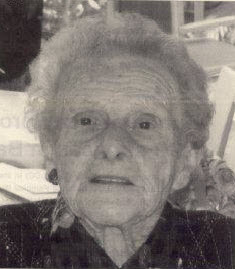
‘Frau Pastor’ Ruby Kriewaldt aged 99

It amuses me how some pastor’s wives today distance themselves from the ministry of their husbands, with the apparent excuse that the divine call was not issued to them. How times have changed! In my experience, the pastor’s wife was considered to be part and parcel of the call.

I was born in 1908, the eldest child of humble parents, Gustav and Helena Wegener, who worked a small farm near Palmer, South Australia. They gave me the name Rubina. After basic schooling at Palmer Primary School, I eventually found work in a local store-cum-post office. I helped my parents with farm work like milking cows, collecting eggs, and feeding the horses. I was active in church, teaching Sunday school and playing the organ.

My parents strongly encouraged me to marry Pastor Emil Kriewaldt from Brinkworth, who had been tentatively courting me while serving the Karoonda parish. We were married in 1932, and my life changed dramatically! At the tender age of 24, I became ‘Frau Pastor’ and felt like a fish out of water.

The first shock I received in my new role was being told by the elders that I would be required to milk two cows to supplement my husband’s stipend. (Thank God I had been a farm girl!) For 30 years, rain or shine, I milked the cows, separated the milk and sold the cream once a week to the butter factory at Balaklava. Sometimes it was necessary to start milking at 5:00 am in order to accompany my husband to various church commitments.

The next shock I received was at my first Women’s Guild meeting. I was informed that it was traditional for the pastor’s wife to be the president of the guild. Although I protested that I had never attended a guild meeting in my life, this didn’t count and I held that position until we left Brinkworth in 1965.

Thanks to my musical ability, I was called upon to play the organ for services at Brinksworth, Blyth, Clare and Canowie Belt. Occasionally I played with my first child, Brenz, tucked into my left arm.

My favorite pastime and hobby was gardening. I love flowers, even plastic ones, and my garden usually looked a picture. It was natural, therefore, that I was expected to provide flowers for weddings. Usually I ended up decorating the church as well. Since it was unforgivable to not use any flowers donated by the members, sometimes I ended up with 20+ vases on or near the altar and along the aisles. I lost count of how many times I did this. It was demanding work and sometimes took two days to complete. Thoroughly tired out from this work, I sometimes also fronted up as the organist and sang a solo for the ceremony.

Since Brinkworth had no suitable accommodation for visitors, the Lutheran manse was expected to be the local B&B. Visiting dignitaries like Sir Robert Nichols. MP, Harold Raymond of the Band Concert fame, pastors and even swaggies were catered for at the manse. Schoolteachers were sometimes given board for up to two years. One week I washed and ironed 27 shirts!

One on occasion, during a heatwave, a district synod was hosted by the Brinkworth congregation, and the manse was expected to cater for the official’s midday meals. At one of the meals a certain pastor announced that he was going to take off his coat because of the heat. All the others followed suit, except the president who declared, ‘My parishioners have never seen my without my pastor’s Rock (coat) even when I am chopping wood, and I have no intention of taking it off now.’

For many years I taught religious instruction at the Brinkworth Area School and accompanied my husband on many visits to the member’s homes and to the hospital. As well as these ‘churchy’ activities, I was engaged in community activities. I was the president of the local Red Cross for many years and an official in the Country Women’s Association. I also taught pianoforte.

Until a new manse was built in the late 1950s, we lived in a badly cracked stone home which featured a wood stove, a sink without a drain, no hot-water service and an outside toilet at the back of the year. However, in spite of these conditions, I raised three healthy boys and have some wonderful memories of the people who passed through our humble dwelling.

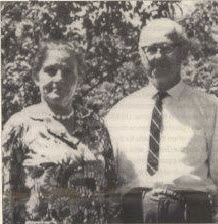
Ruby and Pastor Emil Kriewaldt (‘Krie’) in 1966

In 1966 we left Brinkworth to retire in our own home in Elizabeth. However, it wasn’t long before I was assisting my husband, who agreed to look after the Hillcrest congregation on a part-time basis and to serve as a prison chaplain.

He died virtually with his boots on in 1978. The I found life somewhat quieter and less hectic. Twenty-six years later, in 2004, I gave my garden a fond farewell and moved into hostel accommodation at Mannum, near where I grew up.

I have continued to write and send cards to many people (another passion of mine). In spite of my failing eyesight, which means that I am writing almost from memory, I have sent over 600 cards and letters since moving to Mannum. My sons say that I keep Australia Post in the black!

Following my 100th birthday in October, I thank God for blessing me so richly and keeping me healthy over a long and active life. (I have been in hospital only one day since giving birth to my children.) I thank God for the privilege of being a pastor’s wife. I never minded playing second fiddle to my beloved ‘Krie’ and considered it an honor to serve by his side. Am I old-fashioned?

Source: “They Call Me Frau Pastor,” The Lutheran, 2008. Scanned photocopy provided by Jonathan Brenz Kriewaldt, 23 October 2012.

Missionary Heroes of the Faith: Conrad F. Kellermann (1897-1984)

23 Tuesday Oct 2012

Posted by Kristen James Eberlein in Newspapers

≈ 2 Comments

Tags

Conrad F Kellermann (1897-1984)

“Kelly, you be the preacher. Use your preacher voice!” cheered the young boys playing church on the windswept plains of Missouri. Years later, the powerful voice of that preacher resounded across the crowded congregation, broadcasting the good news of God’s grace. It was a booming voice that resonated for years. The forceful, formal oratory of Rev. Conrad F. Kellermann reverberated down the decades as it spread the gospel of Christ to thousands of people. His voice became his hallmark.

Conrad F. KellermannConrad Kellermann was born August 5, 1897, in Little Rock, MO, the son of Pastor Herman Kellermann. Conrad was named after his grandfather, a prominent St. Louis Lutheran whose construction company helped build Concordia Seminary. As a little boy in dusty overalls imitating his father, “Kelly” loved to preach to his childhood buddies. Conrad received his elementary education in a one-room Lutheran school taught mainly by his father.

After graduating from Concordia Seminary in 1919, he was called to guide a mission field of five stations covering about 100 miles of wilderness on the prairies of western South Dakota. Congregations were organized at Philip and Milesville. He spent nine years as pastor of Trinity-Mansfield, SD. Kellermann accepted a call to St. Matthew’s-Miami in 1932, mainly because he sensed the enormous missionary challenge in the growing area. When Kellermann, his wife, Caroline, and their six children arrived in November 1932, in the depths of the Great Depression, St. Matthew’s was the only Missouri Synod congregation in Dade County and had 69 struggling members. He began an aggressive campaign to build membership and start missions in the Miami area.

One of the high points of his ministry was the baptism of 36 adults and children on Palm Sunday in 1935. There were 200 in Sunday School in those early days. In 1937 Kellermann was a key figure in the organization of the District Walther League. That year St. Matthew’s started a mission on Miami Beach. In 1940 Kellermann conducted the first Lutheran service in Key West and helped start Redeemer-Miami Shores. During World War II he served as chaplain to German prisoners of war in three POW camps in the Miami area.

In 1947, with an impressive 10-year record of coordinating South Florida mission work, he was a pastoral delegate to Synod’s Centennial Convention in Chicago where the petition for the formation of a new Florida-Georgia District was presented. His booming voice and oratorical style implored implored that Christ’s work be further facilitated through this new endeavor. At the Florida-Georgia District organizational convention in Orlando in February 1948, Kellermann was elected President.

While serving as District President, Kellermann’s powerful voice echoed everywhere throughout the Miami area as he continued the mission expansion that resulted in 16 additional LCMS churches in Dade County by 1964.

Kellermann led the District for nine strategic years, from 1948 to 1957, and was named Honorary President in 1959. He was recognized for having successfully led the fledgling District through difficult and challenging years with patience, optimism, faith and unfailing courage.

After 48 years of unflagging Christian service, 35 of them spent at St. Matthew’s and in vocal District leadership, Kellermann retired on March 1, 1967. His ongoing efforts for the Lord were recognized on April 24, 1981, when the District granted him the Doulos tou Christou award for his distinctive service as a trailblazer.

On January 15, 1984, Concordia Seminary-St. Louis, conferred upon Kellermann the Doctor of Divinity degree in recognition of his “concern for the proclamation of the Gospel, his labor as a trailblazing pioneer, the establishment of Lutheranism in South Florida, his expansion of mission work in a burgeoning population, and his leadership in shaping and serving the Florida-Georgia District.”

In the evening of his life, an operation reduced his once-powerful voice to little more than a whisper. Pastor Kellermann said, “My voice is gone, and you know how important a voice is to a preacher.” Today, however, that powerful voice resounds through the years in his lasting contributions, which still speak to us.

Source: Extract from “Missionary Heroes of the Faith,” Lutheran Life, June-July 2008, page 8.

Back to Home in American

21 Sunday Oct 2012

Posted by Kristen James Eberlein in Newspapers

≈ Leave a comment

Tags

Emma B Eberlein (1872-1948)

LAST ARTICLE ABOUT AUSTRALIA, STORY TOLD BY MRS. EMMA KRIEWALDT

DEPARTURE OF THE SHIPS

Breaking Up of Home Ties, When Band Plays and the Great Crowds Sing Songs


‘You see,’ said Mrs. Kriewaldt, ‘after a boy has enlisted in the army, had received training and had shipped to England, it was easily six months from time of enlistment before he saw any fighting. No wonder the boys had the spirit of adventure. When the troops left Australia a demonstration was always given the boys. Great crowds gathered at the wharves. The soldier boys had long paper ribbons rolled up in a roll. One end of this was held by the soldier’s sweetheart, and the other by the soldier on board. As the ship steamed away from from the dock, the ribbon was let out it’s [sic] entire length and still the two held on, until the ribbon had stretched to the breaking point. Thus were the love ties broken in allegory. The crowds sang God Save The King and Rule Brittanica and the bands played patriotic  march tunes.”

“My own boys caught the inspiration, and in all seriousness began to talk of enlisting, and the oldest one, you know, might easily pass the age limit. Well, I tried to show him that what he had seen was only the grandeur of war, that the awfulness of it was something remote, but most terribly real. I then proposed to him that if it were adventure and a trip that he wanted, we would come to American,” said Mrs. Kriewaldt, “and here we are.”

“We have a farm and some other property back there, which I have left in the hands of a good Christian friend until the war is over. No German can sell property there, no one with German blood even three generations removed can sell or buy property without the permission of the government. The reason for this strict rule is that they fear that the money received from the sale might fall in the hands of the enemy. I could have secured permission from the commission I think, but all I would have been allowed to take out of the country was two hundred fifty dollars. So, what was the use?

“Rather than make such sacrifice out of my property, I preferred to leave it with this friend and run the risk of it surviving the war. One of our neighbors went away to fight the enemy and left a wife with ten children. When I think of this, I am so glad that we had this dear America to come to. Naturally my heart is back in that land that meant so much to me, and to my husband and children, but the boys are fast acquiring American ways and I think they are going to like it here, and of course it is easy for me to resume the manners and costumes that I knew in my childhood, in this my native land.”

The End.!

Source: Photocopy of article from the Shawano County Journal, hand-dated Jan 1917; paragraphs added. In the Frederic C. Eberlein genealogical files.

Rev. Herman Kellerman in 1916-1917

20 Saturday Oct 2012

Posted by Kristen James Eberlein in Newspapers

≈ Leave a comment

Tags

Herman H Kellerman (1872-1940)

“Rev. H. Kellermann, the next Pastor of the church, served the congregation from 1916 to 1917, coming from St. Louis, Mo., and was installed by Rev. Paul Heckel of Chattanooga, on May 14th, 1916.

Pastor Kellermann before accepting our call, had been out of the ministry some time on account of impaired health.  But his zeal for the Lord’s work induced him to take new courage, brave the weaknesses of the body and come to us, solely to bring the word of God to thirsting souls.  However he did not recuperate as he had hoped, his health continuing to decline.  A man of exceedingly fine intellect, broadened by travel in foreign countries, bright in mind, willing in spirit, he found himself fettered by an ailing body, unable to continue in the pressing duties connected with pastoral work, in a growing congregation, and although the congregation in its effort to keep him, prevailed on him to take an extended vacation, Pastor Kellermann finally felt constrained to offer his resignation which the congregation reluctantly accepted. He preached his farewell sermon November 11th, 1917, and with his family, took leave for a stay in Southern Florida.”

Source: First Evangelical Lutheran Church,  Fiftieth Anniversary Manual, Knoxville, TN: 1919

Kriewaldt, Eberlein families of service

20 Saturday Oct 2012

Posted by Kristen James Eberlein in Newspapers

≈ Leave a comment

Tags

Emil P Kriewaldt (1870-1916), Emma B Eberlein (1872-1948), Frederic C Eberlein (1919-2010), Martin C Kriewaldt (1900-1960)

By FRANK MEYER
Leader correspondent
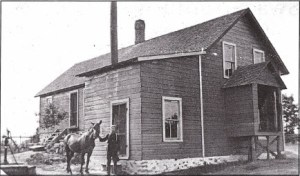
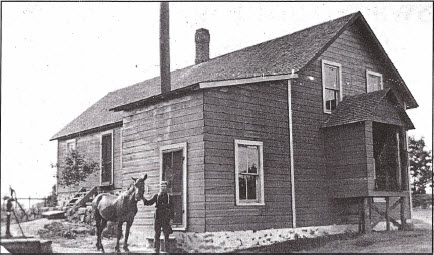
John Kriewaldt with one of his 22 horse [sic] outside the family cheese factory in 1911.

Kriewaldt and Eberlein — two anchor names in the Shawano community with records of distinction and service. Their history constitutes a fascinating story in many unique ways.

Many fields of endeavor — law, public office, dairy farming, cheesemaking, and judiciary service constitute parts of this combined family legacy.

Frederic C. Eberlein, former district attorney and now retired, has provided a detailed chronology of a family history that spans both decades and continents.

One member of this enlarged family, Martin C. Kriewaldt, distinguished himself as a professor of law, a barrister, and wound up as a justice of the Supreme Court in Darwin, Australia.

In 1895 the Rev. Emil Kriewaldt and Emma Eberlein were mamed in Shawano. Emma was born near Hermansfort, where she attended grade school, her family then moved to Shawano. Finishing high school at age 16 she returned to Hermansfort to teach, then to Shawano. The local paper reports that at age 19 at a teachers conference she was assigned the topic of “maintaining discipline in a one room school.”

The Rev. Emil Kriewaldt was a graduate of the Lutheran seminary in St. Louis. Soon after their marriage in 1895 he received a “call” to a Lutheran church in a rural area in South Australia.

Martin was the third of four sons.

In 1914 Australia declared war on Germany. Many people of Germian ancestry were subject to persecution, their homes confiscated, imprisoned, books burned, German-made pianos became kindling wood for patriotic rallies.

The family stood firm until the death of the Rev. Kriewaldt in 1915. Unwilling to face persecution alone, she abandoned her parish and home and returned to Shawano, with her four sons and lived with the Eberlein and Kriewaldt families.

One son worked on a ranch in California, another, living with the Kriewaldt family attended the University of Wisconsin school of agriculture and studied cheese making. The third, Martin attended Shawano High School and graduated in 1918. His classmates, among others, were judge Dillett and Louis Cattau.

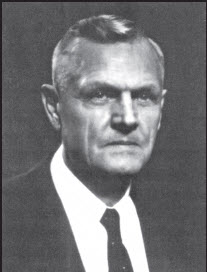
Martin C. Kriewaldt, in a photo from the 1950s — who graduated from Shawano High School in 1918 — was a justice on the Supreme Court in Darwin, Australia. He died in 1960.

Martin received a regents scholarship and attended the University of California at Berkeley, pursued an honors program and participated in varsity debate.

After two years he transferred to the University of Wisconsin law school at Madison, made law review, graduated with honors, elected to Phi Beta Kappa, and was awarded the Vilas medal for forensics.

After the war, he returned to Australia and finished his law training at the University of South Australia law school. He practiced as a solicitor and barrister in Adelaide, and was a professor of real property law at the university, editing a treatise on real property law, still used in Australian and New Zealand law schools.

Commissioned as an officer in the Royal Australian Air Force he served in the South Pacific until the end of the war in 1945. However, he was retained in the military to serve as a judge on a military tribunal which tried Japanese war criminals. The trials, took place on the isle of Morotai — the scene of many atrocities, and included crimes committed against Australian soldiers, depicted in the movie “Bridge Over the River Kwai.”

The world’s attention became directed to the plight of the Australian aborigines, long a persecuted“ people in that land. Judge Kriewaldt was appointed by the prime minister of Australia to replace a “racist judge.” The fairness and temperament of judge Kriewaldt drew exceptional acclaim from the columnist-author Robert Ruark who praised judge Kriewaldt following his sentencing of two wealthy white brothers for “beating six black “aborigines with stock whips.”

The world might be truly proud of Mr. Justice Kriewaldt,” wrote columnist Ruark. At that time such sentencing of white people was extremely rare.

Upon judge Martin Kriewaldt’s death in 1960 the aborigine people accorded Kriewaldt a rare honor and held a ceremonial ritual known as “Corrobore” in his recognition.

A law building in Darwin bears the Kriewaldt name and the capital in Canberra has “Kriewaldt Boulevard.” ”

The Kriewaldts of Australia, the United States and Canada held a family reunion in 1995, the year marking the 1O0th anniversary of their first departure from America.

Attending this event in 1995 were Mr. and Mrs. Arthur Kriewaldt and Mr. and Mrs. Frederic C. Eberlein of Shawano, several cousins from Canada plus about 50 Kriewaldts living in Australia.

“I am proud to say that Justice Kriewaldt was my first cousin and my godfather,” said Frederic Eberlein.

It is worthy of note that the Kriewaldt name and reputation are still of great standing and continues in law practice in Australia. Martin Kriewaldt Jr. of Brisbane, Australia is a partner in the largest firm on the continent and serves on several boards of directors. On occasion he visits relatives in Shawano.

Frank Meyer lives in Shawano.

Source: Frank Meyer, “Kriewaldt, Eberlein families of service,” Shawano Leader. Undated photocopy acquired from Frederic C. Eberlein.
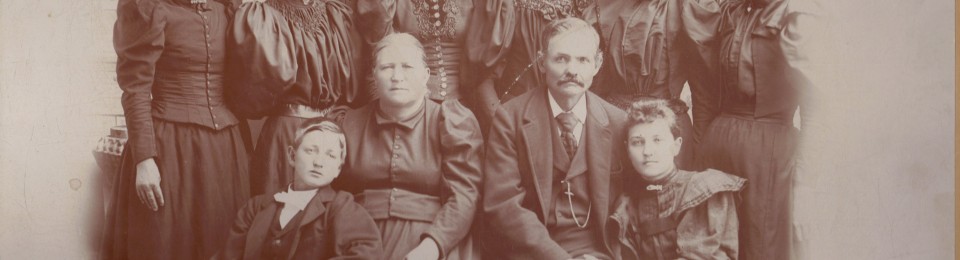
Marriage notice, Fredericka Eberlein and Frederick S. Breed

20 Saturday Oct 2012

Posted by Kristen James Eberlein in Newspapers

≈ Leave a comment

Tags

Frederick S Breed (1852-1931), Fredericka Eberlein (1870-1947)

MARRIED. — Mr. F. S. Breed of Oconto County, and MISS EUREKA EBERLINE [sic] of this city, were united in marriage on Thanksgiving day, Thursday Nov., 29. Rev J. V. Hughes, officiating.

The young bride and groom received the congratulations and well wishes of a large circle of friends.

Source: Photocopy of clipping from the Shawano County Advocate, hand dated November 1888. In the Frederic C. Eberlein genealogical files.

Michael Eberlein examined for state teacher’s certificate

19 Friday Oct 2012

Posted by Kristen James Eberlein in Newspapers

≈ Leave a comment

Tags

Michael G Eberlein (1880-1952)

“Michael Eberlein is well pleased with the returns that he has received so far from the examinations at Madison for a state certificate. He wrote on nine branches and has passed on the five that he has heard from and feels confident that he will pass on the others. He is one of seven that passed in algebra out of over one hundred that tried. He is only seventeen years old and will probably be the youngest holder of a state certificate in Wisconsin. This speaks well of the Shawano High school.”

Source: Photocopy of clipping from the Shawano Advocate, hand-dated June 1898, in the Frederic C. Eberlein genealogical papersa.

Marriage announcement: Natalie Eberlein and Gustav Pludeman

19 Friday Oct 2012

Posted by Kristen James Eberlein in Newspapers

≈ Leave a comment

Tags

Gustave C Pluedemann (1868-1947), Nathalie Eberlein (1871-1954)

“Cards are out announcing the marriage of Gustav C. G. Pludeman to Miss Natalie E. C. Eberlein, and Wilhelm Schenk, to Miss Emille A. W. Pludeman to take place at the residence of Fred Eberlein of this city on the 30th of the month.”

Source: Shawano County Advocate, August 1892.

← Older posts
Newer posts →

Recent Posts

  • Extended Kellerman family, 12 November 1940 Saturday, 22 June 2019
  • Walter F Pluedemann at the Mankato Commercial College Friday, 21 June 2019
  • William Metcher Weds Friday, 21 June 2019
  • Walter Friedrich Pluedemann (1903-1977) Friday, 21 June 2019
  • Kellerman family, 12 November 1940 Thursday, 20 June 2019

Archives

  • June 2019
  • July 2013
  • January 2013
  • December 2012
  • November 2012
  • October 2012
  • September 2012

Categories

  • Art
  • Biography
  • Church records
  • Citizenship
  • Descendant reports
  • Diaries, letters, and manuscripts
  • Ephemera
  • Genealogical research
  • Military
  • Newspapers
  • Obituaries
  • Photographs
    • Family portraits
    • Gravestones
    • Individual portraits
    • Other photographs
    • Wedding portraits
  • Research notes
  • Vital records

Meta

  • Create account
  • Log in
  • Entries feed
  • Comments feed
  • WordPress.com

Blog at WordPress.com.

  • Subscribe Subscribed
    • Eberlein genealogy and photographs
    • Already have a WordPress.com account? Log in now.
    • Eberlein genealogy and photographs
    • Subscribe Subscribed
    • Sign up
    • Log in
    • Report this content
    • View site in Reader
    • Manage subscriptions
    • Collapse this bar
 

Loading Comments...