
Posted by Kristen James Eberlein | Filed under Vital records
06 Saturday Oct 2012
Posted by Kristen James Eberlein | Filed under Vital records
06 Saturday Oct 2012
Posted in Obituaries
Carl A. Eberlein was killed in an auto accident Tuesday night, when the car in which he was riding ran into a load of logs on the overhead between Shawano and Thonrton. He and Francis Dolan had been that afternoon on an business trip to Gresham. They left Gresham about 15 minutes before five to come home by way of highway 29. At the overhead one of the big Ebert trucks, loaded with logs, stood on the concrete, the left rear wheel having fallen off.
Francis was driving. He saw the logs just in time to make an attempt to turn out. He got over to the left far enough to get himself out of the collision, but Carl struck squarely into the logs. Carl’s skull was fractured, his jaw broken, and his body bruised. He was rendered unconscious and did not regain consciousness. He was rushed to the city hospital where he breathed his last at twelve o’clock.
Francis Dolan sustained only a broken nose and minor bruises. He is in the hospital where he is under care of his physcian. If nothing further develops he can be released within a day or two.
Carl A. Eberlein had for several years been district agent for the Northwestern Life Insurance Company. He was a son of Mr. and Mrs. Charles Eberlein of Shawano. He was born in this city October 16, 1901. He attended the public schools and graduated from the high school in June, 1920.
He was ambitious to obtain a college education and upon graduation he went immediately to work in the Iwen box factory. He saved his money and with it entered Ripon College, from which he graduated in 1925. In high school he was a brilliant student. He was active in dramatics and in debate; he studied athletics and was popular with teachers and students.
At Ripon he went out for athletics primarily to study the methods. He became first lieutenant in the Officers’ Reserve corps. He starred in college debate.
Upon graduation he taught for two years in the high school at Gillett where he had signal success as an athletic director. He was well liked as a teacher and his competitors greatly respected him as a coach.
Upon leaving the school work he became district manager for the Northwestern Life Insurance company, his territory including Shawano county and surrounding counties.
He was married July 2, 1930 to Miss Helen Klosterman, daughter of Mr. and Mrs. George Klosterman. The couple have a picturesque, modern home on Lafayette street. There are no children.
Besides his sorrowing young wife he leaves his parents, Mr. and Mrs. Charles Eberlein, his sisters, Edna and Kathryn (Mrs. Charles Raddant) of Shawano, a brother, Frederick, of Green Bay, and a host of friends of the family.
The funeral is to be held Friday afternoon, the Rev. Mr. Ferry to officiate.
Source: Shawano County Journal, 14 December 1933.
06 Saturday Oct 2012
Posted in Obituaries
Edna M. Ladwig, age 90, formerly of 915 Lutz St., Shawano, passed away on Sunday, Sept. 20, 1998, at Heartland Health Care Center of Shawano. She was born in Shawano on July 2, 1908, the daughter of the late Charles and Bertha (Foesch) Eberlein. On August 11, 1935, she was united in marriage to Walter Ladwig in Shawano. He preceded her in death in 1974.
The Ladwigs resided in Cincinnati for many years where Mrs. Ladwig taught music in the Cincinnati Public School system. They retired and returned to Shawano in 1971. Mrs. Ladwig was employed as a piano teacher by the Shawano Park and Recreation Department and also taught private lessons in her home. She was a member of the St. James Lutheran Church of Shawano and a member of the Tabitha Society.
Survivors include: children, Virginia Raleigh, Shawano, Bruce (Betty) Ladwig, Town of Wescott, Shawano, William (Cheri) Ladwig, Ottawa City, Mich,; six grandchildren, Pat, Greg, Hannah, Samuel, Jessica and Zachary Ladwig and many other relatives and friends. She was also preceded in death by her son James W. Ladwig, and a son-in-law, George Raleigh.
Funeral services will be Wednesday, Sept. 23, at 1 p.m. at Schroeder Funeral Service of Shawano with Pastor W.A. Uttech officiating. Internment will be at the Woodlawn Cemetery of Shawano. Friends may call after 11 a.m. on Wednesday at the funeral home until time of services.
In lieu of flowers a memorial fund for the St. James Lutheran Church of Shawano has been established in her memory.
Source: Obituary collection, Family History Center, Shawano, WI.
06 Saturday Oct 2012
Posted in Obituaries
Funeral services for Fred W. Eberlein [1], 58, of Green Bay, will be held Friday afternoon at 1:30 at the Redeemer Lutheran Church in Green Bay, with burial in the Woodlawn cemetery at Shawano. Mr. Eberlein died on Tuesday morning following a short illness.
He was born in Shawano, was a graduate of Shawano High School, attended Lawrence College, and was a veteran of World War I. He worked with the Green Bay and Western Railroad since 1921 and was assistant general auditor at the time of his death. In 1922 he married the former Edna Baewald.
Mr. Eberlein was a member of the Redeemer Lutheran Church and was very active in church affairs, being president of the church choir and a member of the church board of education. He was also a member of the Green Bay Traffic Club.
SURVIVORS are his wife; two daughters, (Louise) Mrs. Dean Batha, Tonawanda, N.Y.; (Carol) Mrs. Gerald Christensen, Green Bay; four grandchildren; his father, Charles D. [sic] Eberlein, Shawano, and sisters (Kathryn) Mrs. Charles Raddant, Shawano, and (Edna) Mrs. Walter Ladwig, Cincinnati, Ohio.
Friends may call at the Findelsen-Greiser Funeral Home from 7 p.m. Wednesday until 11 a.m. Friday and then at the Redeemer Lutheran Church until time of service. The Rev. Harold Brauer will officiate.
Source: Unidentified clipping, hand-dated 18 February 1958, in the collection of the Family History Center, Shawano, WI.
[1] Son of Charles Otto Eberlein (1866-1968) and Bertha Foesch. Grandchild of Frederick John Eberlein (1834-1895) and Catherin Goerner (1841-1906).
06 Saturday Oct 2012
Posted in Gravestones
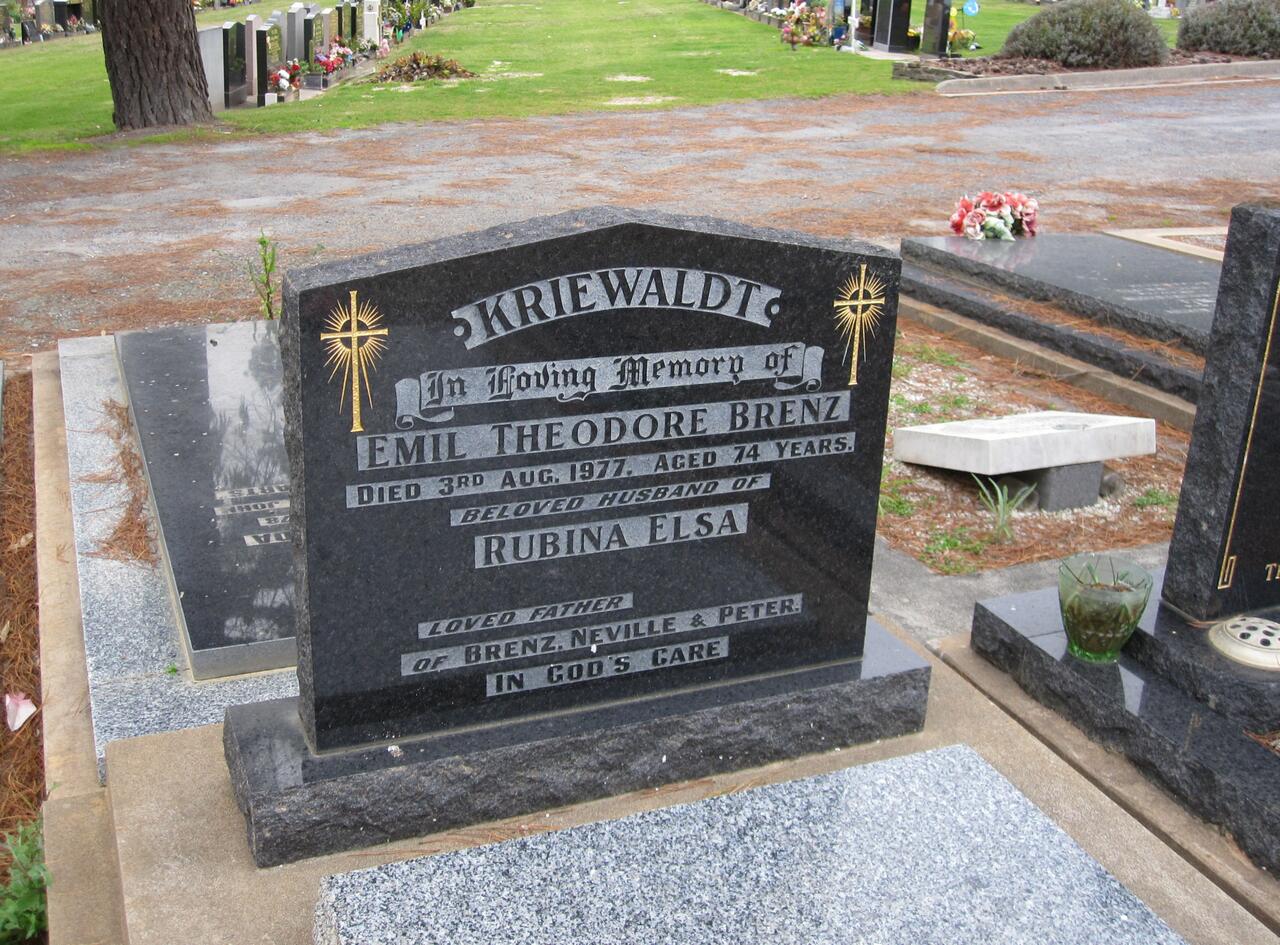
Gravestone for Emil Theodore Brenz Kriewaldt (1903-1977), Municipal Cemetery in Golden Grove, South Australia, Australia. Photograph provided by Gravestone Photographic Resource; copyright held by Gravestone Photographic Resource (www.gravestonephotos.com).
06 Saturday Oct 2012
Posted by Kristen James Eberlein | Filed under Other photographs
06 Saturday Oct 2012
Posted in Newspapers
(To Editor Hamilton “Spectator.”)
Sir, — It was with sorrow and regret that I read the letters published in the columns of your paper recently regarding the Australians of German descent living in our midst. It appears to me these people and their acts need no vindication. They have lived in the Western district, they and their fathers before them, and have never in any way proven themselves unworthy of the trust reposed in them by their fellow citizens. They have done their duty towards their country in every respect through all these long years, and it ill becomes their country to turn against them now and put them on the same standing as aliens.
The War Precautions Bill, as it was passed, is not only an insult to every naturalized Australian of whatever nationality, but is an affront to reason. Such measure could not and would not have been taken by any other country under the sun. Not even Russia would treat her citizens in such as despotic nature.
General Rennenkampf, commander-in-chief of the Russian forces, is of German descent. So is Van Hessen, the chief admiral of the Russian fleet in the Baltic; the Governor-General of Finland, who also is the commander-in-chief of the army of Finland; Lammsdorf, a member of the cabinet; Bauk, the Minister of Finance; are not all these of German descent? Forty percent of the marine officers of Russia are of German descent. The Duma, both the Upper and Lower house, has many members claiming German ancestry. In 1902, 60 per cent. of the members of the Russian ministry were of German descent, and only 40 per cent. Russian. Russia accepts the services of these men with a grateful heart, and would not think of insulting them by doubting their loyalty, or causing them to resign their positions. Shall we be taught a lesson in chivalry by the Russians?
I have been informed that the chief reason we Australians of German descent are regarded with suspicion is because we retain the use of the German language in our schools. Being a native of America, I presume my judgement on this point may be considered more impartial than that of a person born in Germany, and I shall, therefore, briefly give the reasons for our doing so: —
Germans by nature are a people possessing great linguistic abilities. They learn to speak a foreign language with incredible rapidity. Their children of two or three speak German and English and French or any other language which they happen to hear with equal fluency. The Englishman, on the contrary, and I say this with all respect, has not these linguistic abilities, or at least we have never been able to discover them, and it is rare occurrence, indeed, when you find an Englishman speaking any other language than his mother tongue; and if he does so, you may be sure it has cost him a world of persevering work. The Briton speaks but one language, and is quite content if he can speak that properly. These are facts which my observations in America, Germany, Switzerland, Italy, and Australia have tended to confirm.
We find that the pupils attending our schools learn to read English with startling rapidity after having read a year or six months in the German Readers. The German language is essentially a phonetic language. Every letter has its own especial [sic] sound and retains that sound under all circumstances. The English alphabet, on the contrary, as everyone knows, is “redundant, inconsistent and superfluous,” to quote the words of a famous rhetorician. Therefore, the teaching of English presents tremendous difficulties to the beginner. If it were for no other reason than this, we would teach German in our schools in order to assist our pupils in learning English. But of course, this is not the chief reason.
We retain the German language because it is the language of science; a universal language, spoken in all parts of the world, and a language which every truly educated person is proud to be able to speak. German is among the living languages what Latin is among the dead. It is also the language of commerce, and we know that our children, being able to speak English and German, are ready to go out in the world and fight the battle of life well equipped. The knowledge of German will be of inestimable value in earning their daily bread. In America this fact is so widely recognized that it is optional whether a student takes a two year’s course in Latin or in German. Nine pupils out of ten in all high schools of the United States of America prefer to take the two years’ course in German. This is what one would expect from such an eminently practical people whose race is for the almighty dollar.
We retain the use of German in our schools partly on account of our religion. Our hymn books, prayer books, catechism, etc., are all in the German language. We have translated some of these into English, but not all. Those wonderful books of prayer found in every Christian German home have as yet not been translated, and our grand majestic songs, who can translate them? We have seen translations of some of them, and our hearts ached. when the translation was literal and reproduced the true meaning, then the poetry was most abominable, and it jarred upon one’s nerves. When the poetry was beautiful, then, alas, the sentiments expressed were not those of the original, but a very free translation indeed. Who can translate Martin Luther’s hymns and … the vigour, the thrilling … into them? It is impossible.
There are some older residents attending church who do not understand English sufficiently to appreciate an English sermon. They can speak a commercial English, but Biblical English must be learned to be understood. Regeneration, absolution, predestination, etc., have no meaning for them.
But the chief reason why we prefer to hear the Word of God in our mother tongue and sing the grand German chorale is largely a matter of sentiment. We were first taught those Bible verses and sung those songs at our mother’s knee in our earliest infancy. Mother had gone, but we see her still as she lays our little hands in prayer, and bids us say: — “Abba, Vater, Amen.” No sermon we ever heard since can move us so as this and the same words in English cannot reach that answering chord in our heart which her simple “Abba” did.
She told us as soon as we were able to comprehend that she and father left Germany and all their possessions because she would not attend the church which the King wished her to attend. She told us of the weary weeks on the water before the ship on which they fled from these persecutions reached the shores of Australia. She recounted the hardships endured by father and her to earn their daily bread here in the wilderness, but of the great joy in her heart despite of that because she could worship God now according to the dictates of her conscience. How our little hearts leaped for joy to see mother so happy, and how we resolved “just like father and mother” to endure every hardship rather than worship at a strange shrine. There she sang that battle hymn of the church composed by Martin Luther: “A mighty fortress is our God.”
Before these recollections are effaced from the minds of these Australian “Pilgrim Fathers” it is useless to ask why they do not conduct their services in English. A magpie may be taught many things, to mew like a cat, bark like a dog, or squeak like a mouse, but when he is alone with his young he delights himself and them with his own melodious song only. That is a part of his nature, the rest only acquired knowledge. History of all ages amply attests to the fact that a people cling to their ancient customs for hundreds of years in a foreign land. Any King or Emperor who has ever forbidden a conquered race to retain its native customs, religion, and language has always found out to his sorrow that the race was filled with an uncontrollable desire to throw off the foreign yoke even after hundreds of years of patient submission. Kings and Emperors have grown wiser as the years rolled on, and nowhere do we find one now, be he ever so despotic, who does not grant his conquered people full liberty in these respects.
The mother country has always recognized this principal in all her dealing with her children of various hues and languages, and therefore has her rule proven so beneficient [sic]. Her people are a satisfied people, and it often happens that as generation succeeds, these people forget their mother tongue and their ancient customs. Yet she is not discouraged if this never takes place. The Jews speak every language under the sun, and are found in every clime, yet they have retained their language and religion throughout the changing centuries. General Rennenkampf, and all other prominent Russians before mentioned, are not only of German descent but speak German. They have retained the German language in their schools and churches, and speak Russian only when speaking with Russians who do not understand the German language. Although many of them have been in Russia for 400 years, this has not been able to quell in them the love of the mother tongue. Our Australian friends would certainly be afraid to trust the, under these circumstances. The time may come when the German-Australian may become so forgetful of his early traditions and that the German language and the grand German chorales have no charm for him, but I sincerely hope that that day is far distant.
These are our reasons for retaining the German language in our schools, and every fair-minded Australian they will appear sufficient. There may be other reasons which I cannot recall at the present, but a desire to foster disloyal sentiments in the minds of our children is certainly not one of them. It have been very painful to me, as no doubt it has to the majority of the loyal citizens of Hamilton, that the German-Australian has been so grossly attacked in the newspapers and their loyalty doubted. They have done nothing to merit these onslaughts, and I, together with all the fair-minded British inhabitants of Hamilton and district, would esteem it a great favor if these attacks would cease. Nothing but harm can result for such letters, and no possible good.
In this hour of danger, we must all stand shoulder to shoulder, and work for the peace and safety of the British Empire, and those are misguided patriots who think they are serving their country by sowing seeds of discontent and hatred among the people. On every coin used in the United States we find the words, ” E pluribus unum” — “United we stand, divided we fall.” This is a most fitting motto for us at the present time. If we all stand together like one man to work for the welfare of the British Empire, treating our fellow-citizens with the confidence they deserve, then, please God, this war will soon come to an end, and the flag of great Britain, our Union Jack, shall float more gloriously than ever upon peoples of various hues, languages, and religions; yet more firmly united in this — a firm, unfaltering loyalty to the Mother Country and the glorious British Empire.
— I am, etc.
E. KRIEWALDT
Hochkirch, October 31
Source: Spectator [Hamilton, Australia], 11 March 1914. Photocopied clipping in the Frederic C. Eberlein genealogical papers.
05 Friday Oct 2012
Posted in Descendant reports
Tags
Emil P Kriewaldt (1870-1916), Emil T B Kriewaldt (1903-1977), Emma B Eberlein (1872-1948), Martin C Kriewaldt (1900-1960)
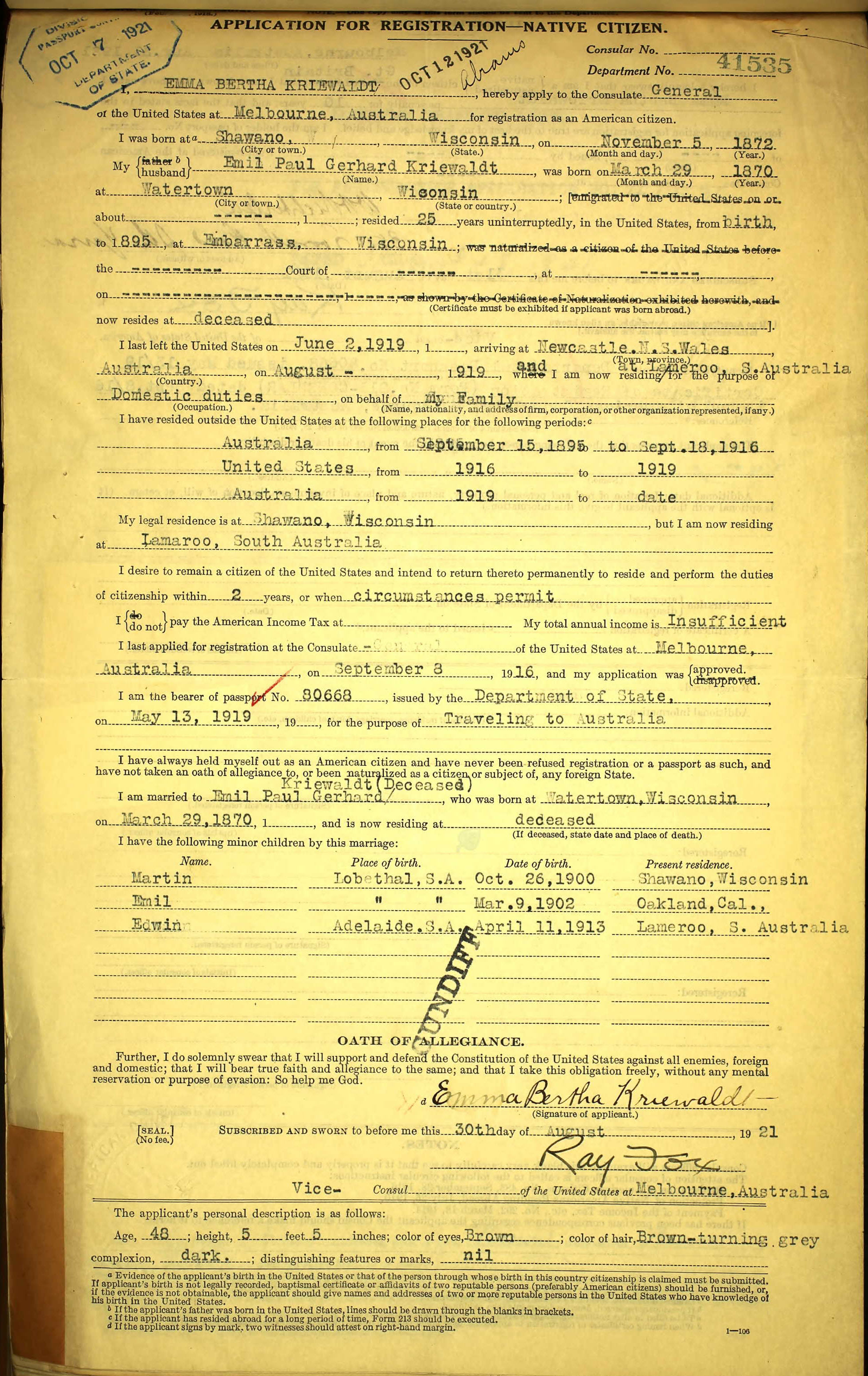
EMMA BERTHA EBERLEIN was born on 05 November 1872 in Herman, Shawano, Wisconsin, USA. She died on 27 December 1948 in South Australia, Australia. She married Emil Paul Gerhardt Kriewaldt, son of Wilhelm Kriewaldt and Henriette Garptiz on 07 July 1895 in Shawano, Shawano, Wisconsin, USA. He was born on 29 March 1870 in Watertown, Wisconsin, USA. He died on 23 May 1916 in Hamilton, Victoria, Australia.
Emil Paul Gerhardt Kriewaldt and Emma Bertha Eberlein had the following children:
i. BABY KRIEWALDT was born on 07 April 1896 in Lobethal, South Australia, Australia. She died on 07 April 1896 in Lobethal, South Australia, Australia.
ii. FRIEDRICH WILHELM ADELBERT KRIEWALDT was born on 07 April 1896 in Lobethal, South Australia, Australia. He died on 27 April 1963 in South Australia. He married Frieda (Freda?) Wilhelmine Ahrns, daughter of Christoph Heinrich Ahrns and Elisabeth Wilhelmina Emma Schmaal on 16 February 1927 in Lameroo, South Australia, Australia (Lutheran Chapel). She was born on 02 December 1904 in Bright, South Australia, Australia. She died date unknown.
iii. WILHELM PAUL GERHARD KRIEWALDT was born on 17 December 1898 in Lobethal, South Australia, Australia. He died on 09 March 1966 in Stanwell, Queensland, Australia. He married EMILIE MAUDE NOSKE. She was born on 29 January 1900 in Hamilton, Victoria, Australia. She died on 03 September 1973.
iv. MARTIN CHEMNITZ KRIEWALDT was born on 26 October 1900 in Lobethal, South Australia, Australia. He died on 12 June 1960 in Adelaide, South Australia, Australia. He married (1) MARY FINLAYSON in 1925. He married (2) EDITH TRUDINGER on 05 February 1948.
v. EMIL THEODOR BRENZ KRIEWALDT was born on 09 March 1903 in Lobethal, South Australia, Australia. He died on 03 August 1977 in South Australia, Australia. He married Rubina Elsa Wegener on 24 May 1932 in Adelaide, South Australia, Australia. She was born on 29 October 1908 in Palmer, South Australia, Australia. She died on 18 February 2012 in Mannum, South Australia, Australia.
Updated Monday, 29 October 2012
05 Friday Oct 2012
Posted in Newspapers
CALLED TO ST. LOUIS
PROF. C. E. KELLERMANN GOES TO BETHLEHEM SCHOOL.
Has Been Head of St. Paul’s School for Past Fourteen Years.
Prof C. E. Kellermann [1], who has been in charge of St. Paul’s Evangelical Lutheran parochial school for the past fourteen years, has accepted a call from the Bethlehem Lutheran Congregation of St. Louis and will take charge of its parochial school next week.
The call of Prof. Kellermann was voted upon last Sunday afternoon at a special meeting’of the voting, members of St. Paul’s congregation. The vote for acceptance was by a very small margin and many who voted for it were reluctant to see Prof. Kellermann go, but allowed their better judgment to prevail through consideration of the fact that he is badly needed in the hew field.
The Bethlehem congregation is one of the largest in St. Louis, having in the neighborhood of 1400 communicant members and the Sunday school has an enrollment of 400. The church is located at Salisbury and Florissant streets and the school is several blocks distant. The school formerly had a corps of six teachers, but at present has two and the enrollment has dwindled down to about 100. Because of the latter and by reason of his ability and reputation, Prof. Kellermann has been chosen as the man who can build up and put new life into the institution.
Prof. Kellermann is serving his last day to-day at the head of St. Paul’s school and will move his family to St.Louis next Wednesday. He will probably be succeeded here by Prof. Ernest Schreiner who has had charge of the intermediate grades for the past several years, and a successor to the latter will be chosen.
Patrons of the school and many both in and out of the church regret to see Prof. Kellermann and his family leave Troy, but under the circumstances they believe he is going into a larger and more prominent field and the results will be a gain to himself and the work.
Source: The Troy Weekly Call, Friday, 30 October 1914
05 Friday Oct 2012
Posted by Kristen James Eberlein | Filed under Citizenship
 Eberlein genealogy and photographs