“Kelly, you be the preacher. Use your preacher voice!” cheered the young boys playing church on the windswept plains of Missouri. Years later, the powerful voice of that preacher resounded across the crowded congregation, broadcasting the good news of God’s grace. It was a booming voice that resonated for years. The forceful, formal oratory of Rev. Conrad F. Kellermann reverberated down the decades as it spread the gospel of Christ to thousands of people. His voice became his hallmark.
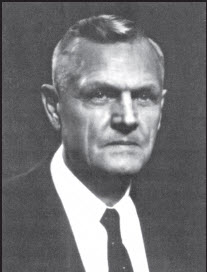 Conrad Kellermann was born August 5, 1897, in Little Rock, MO, the son of Pastor Herman Kellermann. Conrad was named after his grandfather, a prominent St. Louis Lutheran whose construction company helped build Concordia Seminary. As a little boy in dusty overalls imitating his father, “Kelly” loved to preach to his childhood buddies. Conrad received his elementary education in a one-room Lutheran school taught mainly by his father.
After graduating from Concordia Seminary in 1919, he was called to guide a mission field of five stations covering about 100 miles of wilderness on the prairies of western South Dakota. Congregations were organized at Philip and Milesville. He spent nine years as pastor of Trinity-Mansfield, SD. Kellermann accepted a call to St. Matthew’s-Miami in 1932, mainly because he sensed the enormous missionary challenge in the growing area. When Kellermann, his wife, Caroline, and their six children arrived in November 1932, in the depths of the Great Depression, St. Matthew’s was the only Missouri Synod congregation in Dade County and had 69 struggling members. He began an aggressive campaign to build membership and start missions in the Miami area.
One of the high points of his ministry was the baptism of 36 adults and children on Palm Sunday in 1935. There were 200 in Sunday School in those early days. In 1937 Kellermann was a key figure in the organization of the District Walther League. That year St. Matthew’s started a mission on Miami Beach. In 1940 Kellermann conducted the first Lutheran service in Key West and helped start Redeemer-Miami Shores. During World War II he served as chaplain to German prisoners of war in three POW camps in the Miami area.
In 1947, with an impressive 10-year record of coordinating South Florida mission work, he was a pastoral delegate to Synod’s Centennial Convention in Chicago where the petition for the formation of a new Florida-Georgia District was presented. His booming voice and oratorical style implored implored that Christ’s work be further facilitated through this new endeavor. At the Florida-Georgia District organizational convention in Orlando in February 1948, Kellermann was elected President.
While serving as District President, Kellermann’s powerful voice echoed everywhere throughout the Miami area as he continued the mission expansion that resulted in 16 additional LCMS churches in Dade County by 1964.
Kellermann led the District for nine strategic years, from 1948 to 1957, and was named Honorary President in 1959. He was recognized for having successfully led the fledgling District through difficult and challenging years with patience, optimism, faith and unfailing courage.
After 48 years of unflagging Christian service, 35 of them spent at St. Matthew’s and in vocal District leadership, Kellermann retired on March 1, 1967. His ongoing efforts for the Lord were recognized on April 24, 1981, when the District granted him the Doulos tou Christou award for his distinctive service as a trailblazer.
On January 15, 1984, Concordia Seminary-St. Louis, conferred upon Kellermann the Doctor of Divinity degree in recognition of his “concern for the proclamation of the Gospel, his labor as a trailblazing pioneer, the establishment of Lutheranism in South Florida, his expansion of mission work in a burgeoning population, and his leadership in shaping and serving the Florida-Georgia District.”
In the evening of his life, an operation reduced his once-powerful voice to little more than a whisper. Pastor Kellermann said, “My voice is gone, and you know how important a voice is to a preacher.” Today, however, that powerful voice resounds through the years in his lasting contributions, which still speak to us.
Source: Extract from “Missionary Heroes of the Faith,” Lutheran Life, June-July 2008, page 8.

 Eberlein genealogy and photographs