(To Editor Hamilton “Spectator.”)
Sir, — It was with sorrow and regret that I read the letters published in the columns of your paper recently regarding the Australians of German descent living in our midst. It appears to me these people and their acts need no vindication. They have lived in the Western district, they and their fathers before them, and have never in any way proven themselves unworthy of the trust reposed in them by their fellow citizens. They have done their duty towards their country in every respect through all these long years, and it ill becomes their country to turn against them now and put them on the same standing as aliens.
The War Precautions Bill, as it was passed, is not only an insult to every naturalized Australian of whatever nationality, but is an affront to reason. Such measure could not and would not have been taken by any other country under the sun. Not even Russia would treat her citizens in such as despotic nature.
General Rennenkampf, commander-in-chief of the Russian forces, is of German descent. So is Van Hessen, the chief admiral of the Russian fleet in the Baltic; the Governor-General of Finland, who also is the commander-in-chief of the army of Finland; Lammsdorf, a member of the cabinet; Bauk, the Minister of Finance; are not all these of German descent? Forty percent of the marine officers of Russia are of German descent. The Duma, both the Upper and Lower house, has many members claiming German ancestry. In 1902, 60 per cent. of the members of the Russian ministry were of German descent, and only 40 per cent. Russian. Russia accepts the services of these men with a grateful heart, and would not think of insulting them by doubting their loyalty, or causing them to resign their positions. Shall we be taught a lesson in chivalry by the Russians?
I have been informed that the chief reason we Australians of German descent are regarded with suspicion is because we retain the use of the German language in our schools. Being a native of America, I presume my judgement on this point may be considered more impartial than that of a person born in Germany, and I shall, therefore, briefly give the reasons for our doing so: —
Germans by nature are a people possessing great linguistic abilities. They learn to speak a foreign language with incredible rapidity. Their children of two or three speak German and English and French or any other language which they happen to hear with equal fluency. The Englishman, on the contrary, and I say this with all respect, has not these linguistic abilities, or at least we have never been able to discover them, and it is rare occurrence, indeed, when you find an Englishman speaking any other language than his mother tongue; and if he does so, you may be sure it has cost him a world of persevering work. The Briton speaks but one language, and is quite content if he can speak that properly. These are facts which my observations in America, Germany, Switzerland, Italy, and Australia have tended to confirm.
We find that the pupils attending our schools learn to read English with startling rapidity after having read a year or six months in the German Readers. The German language is essentially a phonetic language. Every letter has its own especial [sic] sound and retains that sound under all circumstances. The English alphabet, on the contrary, as everyone knows, is “redundant, inconsistent and superfluous,” to quote the words of a famous rhetorician. Therefore, the teaching of English presents tremendous difficulties to the beginner. If it were for no other reason than this, we would teach German in our schools in order to assist our pupils in learning English. But of course, this is not the chief reason.
We retain the German language because it is the language of science; a universal language, spoken in all parts of the world, and a language which every truly educated person is proud to be able to speak. German is among the living languages what Latin is among the dead. It is also the language of commerce, and we know that our children, being able to speak English and German, are ready to go out in the world and fight the battle of life well equipped. The knowledge of German will be of inestimable value in earning their daily bread. In America this fact is so widely recognized that it is optional whether a student takes a two year’s course in Latin or in German. Nine pupils out of ten in all high schools of the United States of America prefer to take the two years’ course in German. This is what one would expect from such an eminently practical people whose race is for the almighty dollar.
We retain the use of German in our schools partly on account of our religion. Our hymn books, prayer books, catechism, etc., are all in the German language. We have translated some of these into English, but not all. Those wonderful books of prayer found in every Christian German home have as yet not been translated, and our grand majestic songs, who can translate them? We have seen translations of some of them, and our hearts ached. when the translation was literal and reproduced the true meaning, then the poetry was most abominable, and it jarred upon one’s nerves. When the poetry was beautiful, then, alas, the sentiments expressed were not those of the original, but a very free translation indeed. Who can translate Martin Luther’s hymns and … the vigour, the thrilling … into them? It is impossible.
There are some older residents attending church who do not understand English sufficiently to appreciate an English sermon. They can speak a commercial English, but Biblical English must be learned to be understood. Regeneration, absolution, predestination, etc., have no meaning for them.
But the chief reason why we prefer to hear the Word of God in our mother tongue and sing the grand German chorale is largely a matter of sentiment. We were first taught those Bible verses and sung those songs at our mother’s knee in our earliest infancy. Mother had gone, but we see her still as she lays our little hands in prayer, and bids us say: — “Abba, Vater, Amen.” No sermon we ever heard since can move us so as this and the same words in English cannot reach that answering chord in our heart which her simple “Abba” did.
She told us as soon as we were able to comprehend that she and father left Germany and all their possessions because she would not attend the church which the King wished her to attend. She told us of the weary weeks on the water before the ship on which they fled from these persecutions reached the shores of Australia. She recounted the hardships endured by father and her to earn their daily bread here in the wilderness, but of the great joy in her heart despite of that because she could worship God now according to the dictates of her conscience. How our little hearts leaped for joy to see mother so happy, and how we resolved “just like father and mother” to endure every hardship rather than worship at a strange shrine. There she sang that battle hymn of the church composed by Martin Luther: “A mighty fortress is our God.”
Before these recollections are effaced from the minds of these Australian “Pilgrim Fathers” it is useless to ask why they do not conduct their services in English. A magpie may be taught many things, to mew like a cat, bark like a dog, or squeak like a mouse, but when he is alone with his young he delights himself and them with his own melodious song only. That is a part of his nature, the rest only acquired knowledge. History of all ages amply attests to the fact that a people cling to their ancient customs for hundreds of years in a foreign land. Any King or Emperor who has ever forbidden a conquered race to retain its native customs, religion, and language has always found out to his sorrow that the race was filled with an uncontrollable desire to throw off the foreign yoke even after hundreds of years of patient submission. Kings and Emperors have grown wiser as the years rolled on, and nowhere do we find one now, be he ever so despotic, who does not grant his conquered people full liberty in these respects.
The mother country has always recognized this principal in all her dealing with her children of various hues and languages, and therefore has her rule proven so beneficient [sic]. Her people are a satisfied people, and it often happens that as generation succeeds, these people forget their mother tongue and their ancient customs. Yet she is not discouraged if this never takes place. The Jews speak every language under the sun, and are found in every clime, yet they have retained their language and religion throughout the changing centuries. General Rennenkampf, and all other prominent Russians before mentioned, are not only of German descent but speak German. They have retained the German language in their schools and churches, and speak Russian only when speaking with Russians who do not understand the German language. Although many of them have been in Russia for 400 years, this has not been able to quell in them the love of the mother tongue. Our Australian friends would certainly be afraid to trust the, under these circumstances. The time may come when the German-Australian may become so forgetful of his early traditions and that the German language and the grand German chorales have no charm for him, but I sincerely hope that that day is far distant.
These are our reasons for retaining the German language in our schools, and every fair-minded Australian they will appear sufficient. There may be other reasons which I cannot recall at the present, but a desire to foster disloyal sentiments in the minds of our children is certainly not one of them. It have been very painful to me, as no doubt it has to the majority of the loyal citizens of Hamilton, that the German-Australian has been so grossly attacked in the newspapers and their loyalty doubted. They have done nothing to merit these onslaughts, and I, together with all the fair-minded British inhabitants of Hamilton and district, would esteem it a great favor if these attacks would cease. Nothing but harm can result for such letters, and no possible good.
In this hour of danger, we must all stand shoulder to shoulder, and work for the peace and safety of the British Empire, and those are misguided patriots who think they are serving their country by sowing seeds of discontent and hatred among the people. On every coin used in the United States we find the words, ” E pluribus unum” — “United we stand, divided we fall.” This is a most fitting motto for us at the present time. If we all stand together like one man to work for the welfare of the British Empire, treating our fellow-citizens with the confidence they deserve, then, please God, this war will soon come to an end, and the flag of great Britain, our Union Jack, shall float more gloriously than ever upon peoples of various hues, languages, and religions; yet more firmly united in this — a firm, unfaltering loyalty to the Mother Country and the glorious British Empire.
— I am, etc.
E. KRIEWALDT
Hochkirch, October 31
Source: Spectator [Hamilton, Australia], 11 March 1914. Photocopied clipping in the Frederic C. Eberlein genealogical papers.

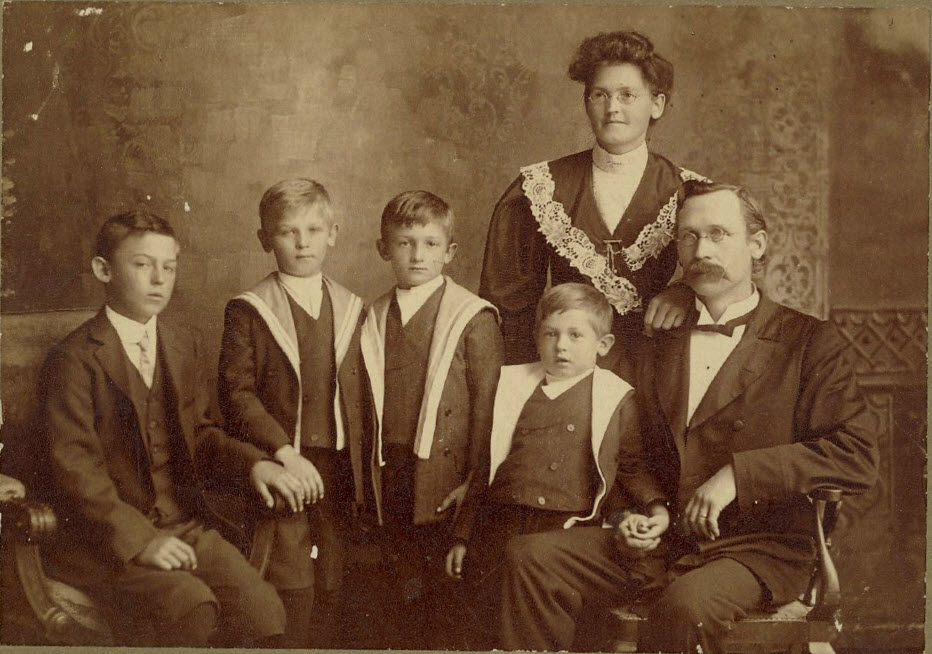
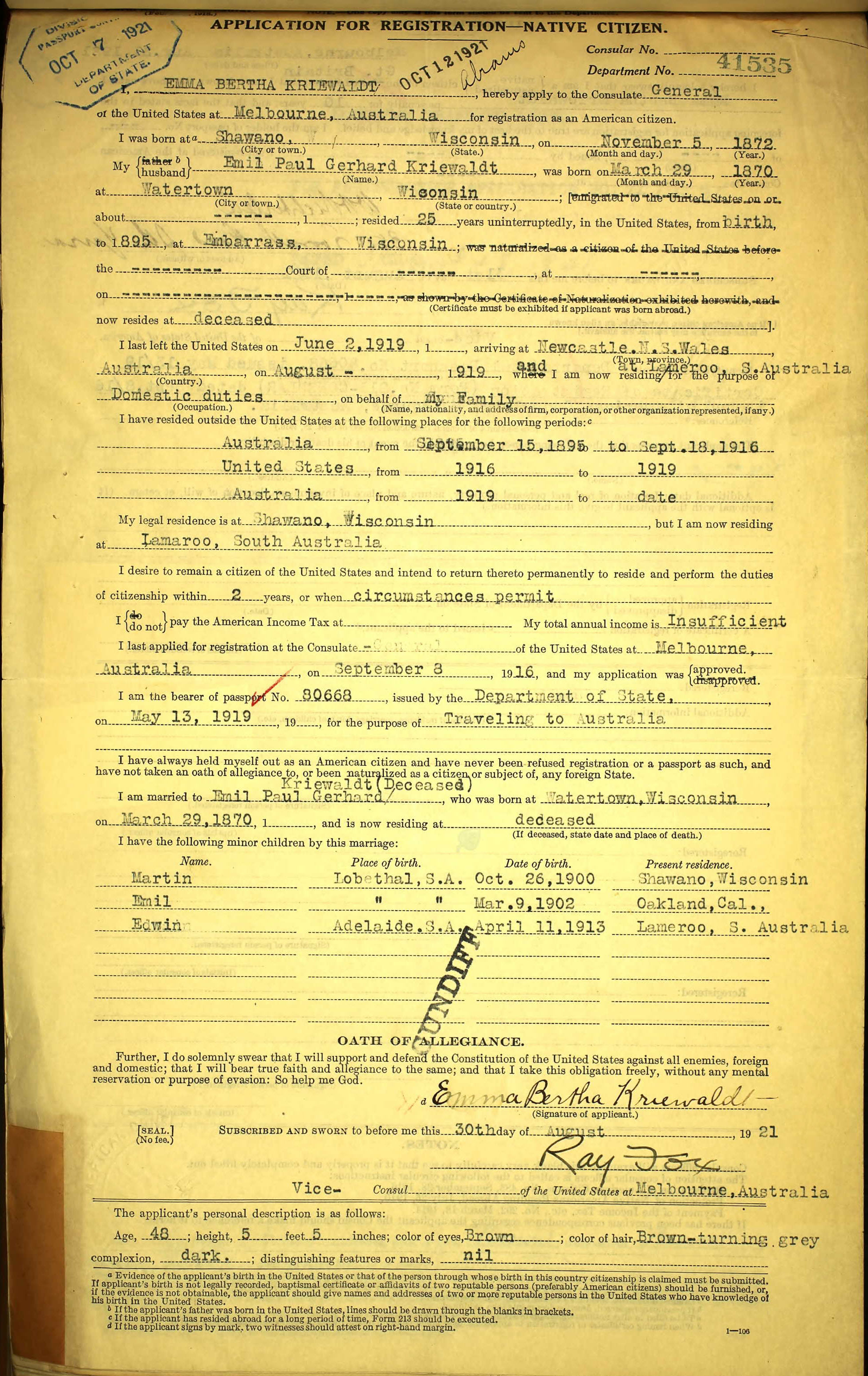
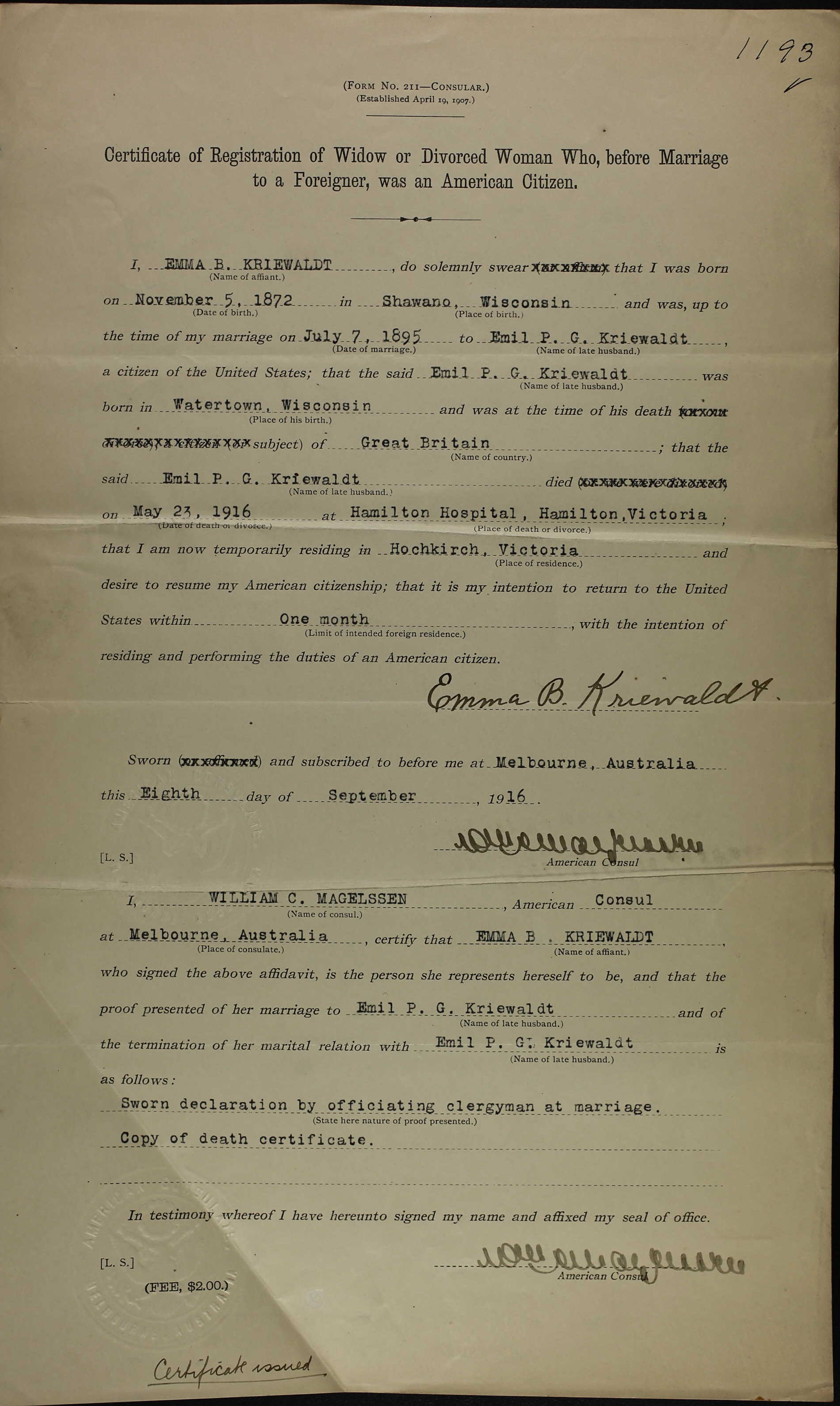
 Eberlein genealogy and photographs